Saturday, January 31, 2009

Stanley


Stanley had lived his life as most men do. He had worked, married, had two children, a boy and a girl, and raised them well. Better said, he provided the means for his wife to do that, for with her first pregnancy, she had quit her job as an elementary school teacher to stay home and raise children. Stanley went up the ladder and became successful, though his job kept him away from home much of the time. Midwesterners with midwestern values, they enjoyed simple things, wholesome meals and Christmas specials on TV and trips to the State Fair. The children grew and went to college and began their own lives, after which they were too seldom heard from or seen. Stanley retired and he and his wife decided it was time to leave the cold winters of life behind, and they bought a beautiful condo on the crystal waters of the west coast of Florida. It was time to enjoy themselves. It was time to travel.

From the outside, the marriage looked like many. The intimacy that had built up over the years took the form of shared experiences, of memories that differed in modest ways, of arguments that had been put aside through mutual agreement, marginalized to the form of bickering. And like other couples who stay together a lifetime, that had become their intimacy. Stanley wasn't a man you wanted to hug. There was nothing wrong with him in particular, but like old dogs that become misshapen and lumpy with age, with hair grown course and thin, and arthritic bones and shortened tendons that make rising a miserable duty, he had through practice become grumpy and solitary, taking his cup of coffee to the porch in order to smoke. Alone.

Observing him, you might wonder what cranky ideas went on in his head, wonder what resentments he argued with himself, ever his logic triumphing over the wrongness of the world. There, in his own mind, like the rest of us, he won again and again the victories that were becoming ever more elusive elsewhere. But like that old dog lying in the sun, paws twitching and legs flinching in some invisible race where once again it is young, chasing squirrels and rabbits with grace and agility, he thought of things you or I might not guess, of unknown pleasures he might once again pursue.

We can never be ready when it happens, that failing of the body, the first inkling of wrongness, the obvious betrayal of matter and of time.

Like Willy Loman, we are all heros in the end, the magnificent sacrifice we call our lives.

Thursday, January 29, 2009

Panic Song After a Sleepless Night


How does one file for bankruptcy? Not the financial bankruptcy that is so on everyone's minds right now, but the other? The one where you have too many things to think about and do and not enough time or energy to do them? The one where the rules have been changed and you can't adapt? The one where you can't sleep for thinking? The one where weeks go by without you doing what it is you wanted to or meant to do? You know the one I mean. I needn't go on.

When I walk across a college campus, though, nothing seems to have changed. The fall of heroes has not touched those youths except to make new opportunities.

It is nothing new, I guess, this falling perpetually behind. It must have gone on throughout the centuries.

But it doesn't help, I think. The sleepless nights, the mild depression and the panic attacks, the feeling that one is alone. Poor aged wretches. Don't worry. There is someone behind you to help you down the ladder.

Wednesday, January 28, 2009

Updike's Departure


John Updike died yesterday. Sickness and death are everywhere, I guess, but that is no consolation. But Updike is one of the lucky ones who will be remembered, who will live on through his characters and observations. Rabbit Angstrom is now as much a part of the American mythology as Lady Brett Ashley and Daisy Buchanan, I think.

In memoriam, I will tell of my meeting with Updike at the PEN/Hemingway First Fiction Awards at the John F. Kennedy Library. I had been invited for reasons I will not divulge here having to do with Cuba, Patrick Hemingway, Radio Havana and the Havana Tribune, rum, women, the city's mayor, and The Hemingway Review. That is all I will say here and now.

For whatever dubious reason, though, I was invited, and what an affair it was, a veritable Who's Who of literature and celebrity. In truth, I can't remember who won the prize. I've looked back at the winners this morning and I swear I am even vague about the year. I have a collection of clippings, though, in a file at the office, and I will look them up today to find the date. I am like this about most things.

I will cut to the chase. Following the awards ceremony, there was a big reception where everyone ate and drank and mingled. I spent most of my time with academics and scholars, but at some point I found myself positioned next to Caroline Kennedy. I knew that there would be an immediate chemical reaction, that we would make eye contact and there would be that spark. But at that moment she was engaged in conversation with Annie Prouxl and Patrick Hemingway, and before I could catch her eye, John Updike and George Plimpton had moseyed over and joined the conversation. Someone I knew was just finishing up a critical book on Updike with whom he had been in close contact for a year of research, and he told me before I went to make certain that I told John hello. And so I did.

"Mr. Updike," I said with great deference, "Larry __________ asked me to give you his greetings."

Updike, who was very tall and hawk-like in appearance drew himself to his full height and looked down his considerable nose at me as if he had just gotten a whiff of something very bad. And with that and nothing further, he turned his back and stepped to the bar. Quickly in my embarrassment, I shot a look at Caroline who just as quickly averted her eyes. That had not gone well at all, I thought, just as Plimpton, who was equal to Updike in height, put his long arm around my shoulder and said, "Don't worry about that, John's an asshole to everyone." I guess I felt succored. Plimpton and I continued to talk for some time. He told me horrific stories about Updike's sexual escapades and I pitched a book idea I had concerning him and Peter Matthiessen and the entire Tall Young Men of Paris crowd. He liked the idea, but like most things in my life, I let the opportunity slip and slide into obscurity.

In spite of Updike's horrifically embarrassing treatment of me at the awards reception, I wish him a speedy journey into the afterlife. He leaves behind a bucketful of good observations.

I've looked high and low for a photo of one of the Hemingway boys and me in Paris, Boston, or Havana, but I was not prepared for this and cannot lay my hands on them. As I say, most of my life is this way. Instead, I will post a picture of my father. He would have been eighty-nine today. He was a swell guy who got a kick out of things. He taught me that (and much more).

Tuesday, January 27, 2009

China Book


Sorry for the late post yesterday.  Life gets away from you, sometimes, no?  I have spent the morning scanning images from a book I made at Anna Tomczak's house that she wants to use in a seminar she is doing tomorrow at FotoFusion in south Florida.  I haven't looked at the book since I did it.  I remember being disappointed in it and thought of it as an experiment.  I had already worked the images up once into a romantic version of a China that didn't exist when I went there a couple of years ago.  But when I went back and began scanning, I found some charm in the images.  I may try that again sometime.  I'll post a few here for your discrimination.  


I want to get back to writing the vignettes, but something has happened and I've lost something important, some ingredient, that was keeping it all going. I hope I find it again, soon. At present, though, there seems to be little but the frustration of Adam's Curse, though there are others, too.


Fan-Tan. No one can write a novel like that again. I must have been drunk to put that on my blog.

Monday, January 26, 2009

This Evening's Paean


I've lived in warm climes (did I use that word?) (voluntarily?) so long, that cold is only an exotic thing, a desire associated with skiing and climbing mountains--you know, heros things.  Tonight, my doors are open and the cool air mingles with Astrud Gilberto and Bill Evans.  I have had it, of course, but there is no use speaking of it.  I want to--and will--at some date distanced by time and circumstance.  But tonight my respite is wine and whiskey and these sweet sounds of Brazilian Jazz.  Oh, God, one thinks, to be transported to one of those movies--you know, the one's associated with decades old Banana Republic catalogues, the one's before the Gap bought them, and the first Peterson catalogs based on writing more than merchandise.  Yes, tonight I have had it.  I'm a goner.  But I won't speak of it.  No.  I'll only drink the whiskey and the wine and read through good memoirs and think of old love that reached its Zenith before it fell into the anonymity of time.  I love everything tonight that isn't work, everything that was, all heroes and heroines, all blood consciousness that arose to a Lawrencian sensuality or the sensibility of a young (not older) Sylvia Plath, to all youth that knows not aging or death, to everything that aspires to heroism (though it may fall well short) or merely drinks in a fabulous bar on some mythical coast where all lovers and heros drink.  

I ramble, but I do not complain, which is the danger of this evening.  This is my paean to you, all lovers alone tonight, to everyone whose passion reaches to the moon (as well as to the nippy air or the frost on the ground or to those cool blue waters off the shores of islands we loooong for tonight).  Forget your misery for a moment, I say, and drink and listen and dance to those inciting tunes that call us at times.  

(Did I mention the whiskey and the wine?) (Truly, a rough day).  
BAM! POW! PLUNK!  Adam West's Batman was a more appealing form of violence, a cartoon alternative to the ratatatat of the footage from Vietnam.  

Sunday, January 25, 2009

Burst

If you've read the comments section of my posts recently, you've probably come across the poetry of Lisa Nickerson.  I like that she leaves them here, but I wanted to make the poems more accessible, so I asked her to let me link her site.  Rather, she wanted to link her e-zine Burst.  Very generous, I would say.  Here is  a poem by one of her contributors, Maria Cianni. Please follow the link and have a look. It will be well worth the effort.

Walking Time 

All morning long I follow my
shadow; above an anonymous balloon
bursts, white, no strings.
I want to be a peacock,

a synthesis of colours, lily
perfume, music; find a new
way of seeing.

Kierkegaard eating honey
on a freshly baked roll.
Honey and choices, brave,
that's all. That's all?
Maybe Chopin.

A walk begins and ends in shadows.
That bus ride across Europe,
those places I never learned to
pronounce correctly, passionate
cracks of dawn, carry on.

Any day will do, any place.
The smell of yesterday is gone.

Saturday, January 24, 2009

The Change


A break in the narrative thread.  There seemed to be no story in the traditional sense, just mood and tone and atmosphere.  New fellows, new faces.  Rhett.  He was fifteen and a pool shark.  He played for money most nights at the local pool hall, but it got to where nobody would play him any more, so he had to start shooting downtown.  I watched him play a few times, and in the end, I couldn't believe that grown men would simply hand over so much money to him.  I guess being such a kid helped him out in that.  But soon, nobody in town would play him, so he did the oddest, most incomprehensible thing I'd ever heard of.  He began flying to Atlanta on the weekends to play there.  I couldn't imagine my parents doing this, let alone a fifteen year old kid, but I knew it was true because soon he had a lot of money.  

When he turned sixteen, he bought a van, and it wasn't long before he found that he could make even more money selling drugs than playing pool.  He had made some connections in Atlanta, and now he could drive up instead of flying.  Steve and Rhett became good friends, and soon he was smoking pot and dropping acid on the weekends.  One night at the drive-in, Rhett parked his van sideways in the front row where nobody parked so that the driver's side of the van faced the screen.  At the time, two of the side panels were missing and the seats were out, so he had thrown in a mattress.  It was a party.  Everyone one was coming up and Rhett was dealing right there.  People were tripping, but I declined.  In truth, it was just sad to me, or I was.  This was the drive-in that I came to with my parents.  I'd always loved that, the family outing.  My mother would pack up food and we would watch the double feature, or they would, for I'd always fall asleep in the back seat before the second movie was done.  But here I was now, with a group of drug-addled loonies.  It was more than a crime.  It was a blasphemy.  

Still, there I was, sitting with the loonies and hoodlums, the thieves and would-be gangsters.  When Sammy passed me a joint, there was nothing to do but take my first hit.  I tried not to inhale.  But just then, a fellow came up who wasn't part of this crowd.  He was a minor athlete, a hanger on around the good kids, the ones who planned the prom and did bake sales and car washes to raise money for some cause or another.  He was big but soft and rather vague looking, a sort of "me too" kid on the periphery of things, a footman for that to which he aspired.  His father was a deputy sheriff.  We all knew that.  

"Hey," he said with a big, toothy smile, "what's going on?"  Everyone began to howl.  "What's going on?  Is that what you said?  Oh man, oh man, what's going on?  Did you hear that?  Did you hear that?"  If everyone hadn't been so fucked up, I'm sure he would have gotten a beating, but instead, someone passed him a joint.  The smile had passed now from his face, and without another word, he slipped into the darkness.  He was gone.  

"He was taking names," somebody said, and in a few days, we heard it was true.  Everyone who was in the van was now on some list at the police department.  

"He's a narc," they said.  

I was not there when the next thing happened, but Steve was and he swore it was true.  One night, the dick-brained narc, this big, vague idiot, showed up late at the pool hall.  This was not his hang out and not a place where he belonged.  He was just hanging out, they said, like some goofball, when Sammy confronted him by a car in the parking lot.  

"Are you a narc?" he asked him, and the dick-brain said, "No, man, I'm just hanging out."  And with that, Sammy put a gun to dick-brains temple and said, "I think you are a narc, and if I find out that you are, I'm going to kill you."  Dick-brain went all to pieces then, slobbering and crying and trembling and begging, but Sammy was unmoved.  "I'm going to kill you if I see you again, cocksucker, you understand that?  I'm going to kill you."  

No one saw dick-brain after that.  He didn't come back to school, and in a little while, his family moved.  

I guess there is a narrative there, but that is not how I remember it.  I just remember that everybody was changing, and everything was different.  The world was suddenly getting crazy, everything ratcheted up.  It was like a bad fog on a night when you just want to get home.  

Friday, January 23, 2009

Monkish


And so. . . I seek the monkish life.  When things go bad, I most often think that I want to live in a monastery.  I romanticize monastic life.  It seems so peaceful, contemplative and quiet, but I am sure that it gets as boring as everything else.  I've tried to prepare myself to be a monk for many years, practicing meditation and Baba Ram Dass's "Be Here Now" philosophy.  But I get lazy and fall away from it like a Catholic from the church, never blaspheming, really, but just getting lazy.  

But I have been concentrating again on monkish things while staying in the world.  Oh, it would be a luxurious monk, for sure, eating and drinking well and sleeping under wonderful blankets and comforters.  But I am OK with that.  I am ready to concentrate on the environment I make ("ou habitez-vous?" is a serious question), and the food I eat, on walking and looking and listening with full awareness.  Sounds simple, but it is really setting the bar high.  
What I want is very simple and so very difficult.  I want to live a full emotional life without depending on others to provide it.  I don't want to deaden my emotions but to heighten them.  And so I will stay alive in my rituals and routines without letting them become deadened habits.  Not easy.  I'm struggling to remember a phrase, but it won't come.  Ah, yes. . . a secular transcendence.  No, that is not quite it.  Frustrating.  

I called a bookie.  He's making odds.  

It has stayed unusually cold here, below freezing, for three nights.  But the days are clear and bright and the light quite magical. Hemingway had it right, though, when he said, "at night it's another thing."  

Thursday, January 22, 2009

Subversive


Reading.  It was liberating and subversive.  The world I read about was not the one I inhabited.  It seemed that something was being kept from me or I from it.  Something was going on somewhere that I wasn't supposed to know about.  I got the news, of course, every night from Walter Cronkite, and so I knew about current events.  There was a war in Vietnam and people were dying.  There were protests against the war in other places, but I never heard anyone say anything against it.  Negroes were marching, too, and now there was forced integration.  The neighborhoods surrounding me were full of people raised in the deep south, people from Texas and Mississippi and Alabama and Georgia, working class people who did manual labor and spoke in accents so deep and rich that at sometimes I thought they were kidding.  Our school had been integrated that year, but not by students.  We had gotten three black teachers, and I had one for math.  She was a skinny, nervous woman who hardly smiled.  For many, it was an outrage, but there was no real trouble about it beyond the inevitable epithets spoken in hallways and the dramatically disapproving postures of burr headed boys slumping in their seats who answered "What?" to every question they were asked.  For many, Alabama's Governor was a hero.  He was running a campaign for President on the Independent Party ticket and it seemed that most people where I lived supported him.  

I think it was Wallace that scared me most.  His hatred was ugly and large.  He promoted violence against "niggers, hippies, and jews," and vowed to run over any protesters who stood in front of his car.  Among the people I dwelt was an anger you could smell, a danger you could taste.  Wallace's validation of violence was welcomed by people for whom it was second nature, for whom fighting was a right of passage and a source of knowledge.  It was how men were valued and ranked.  That was our hierarchy.  

But in the pages of Life magazine, I saw something else.  Bobby Kennedy promised a return to Camelot, they said.  And you could believe in it, too, if you looked at those photographs.  I couldn't understand how someone would choose the face of Wallace over the face of Kennedy, those gestures caught mid-movement on the opposite sides of grace.  

It was Playboy magazine, however, that truly captured my imagination.  Each month, I read every word in the publication, cover to cover.  Of course, I was enamored of the pictures, too.  Those impossible women who beamed out from the pages were nowhere to be seen in my town where you needed only a single good feature to be considered attractive, nice hands or pretty skin or hair that was naturally wavy.  But the words lit me up.  I had never heard such ideas uttered before, and surely I understood little of what I read.  Still, in my unknowing conscience, I thought there was a greatness to what was discussed, to the way it was said.  I knew there was a philosophy and a politics involved but it was presented as something tangible, something you could eat and drink and drive.  The allure was overwhelming for a teenage boy.  It was tangible, I thought, and I would have it.  

Wednesday, January 21, 2009

"Is"


My favorite part of yesterday's celebration was when the Munchkins came out and sang "Ding dong, the witch is dead. . . ."  That was really something.  Obama's speech, though, got me thinking about virtues, so I posed the question to people I met: "What's your greatest virtue?"  In truth, mine was evasive.  I am still thinking.  It made me think of moral codes, too, those guiding values by which we live our lives, that let us make distinctions about good and evil.  I find that most people have a very difficult time articulating their moral codes.  Try it.  Then try living by it consciously for two weeks and see if it is difficult.  Most people I query break their moral code several times a day.  And this is the same moral code by which they value others whose own codes are different, if not in word, then in mood or emphasis.  

Obama's speech got me thinking about all of this, and of course, it was a terrible night.  Obama's speech urged us to put away childish things, and I wonder about that.  I know that he means those selfish, spoiled, and wasteful things of a spoiled child and is not referencing those wonderful parts of childhood, the whimsical, joyful thrill of simply existing, the natural part of life as opposed to the fashioned, mechanical things.  Surely he meant that, right?  I think he should have said so.  

But I am with him.  We must be more productive.  To make things, to have skills, to work with metal and wood and the land--those actions are to be honored.  Still, it is hard for me to get excited about a world where you can count on getting a job in a factory.  I keep wondering how many factory jobs he has held, how many times he has tilled the land.

But I am parsing from the cheap seats.  I, too, am tired of people who do not pull their weight, who use resources without giving back, tired of the drug dealers who wave to me as I go to work with superior grins, tired of the wise guys at the Y in their expensive ties who know how to fix the economy.  Sloth and Greed and Avarice are everywhere.  Those are definitely "do nots" in my moral code.  

I ended my evening alone after a particularly memorable exchange in which I was asked to question who cared for me.  The list, according to my questioner, is notable for its brevity.  I think that worked on me, too, as I lay in my bed on the coldest night of the year, wondering about the challenges that face me, both individually and collectively.  But perhaps last night, as the Obama's danced the evening away into history, many of us were thinking about the same things, wondering about our place in the world, about what we've done to bring us here, about our deeds and responsibilities and about the seismic shifting in social values and codes.  

There is a new moral order, I think, by which we all must evaluate our lives.  

But I am still mostly haunted by "childish things."  I do love them so,  preferring the "is" to the "un".

you said Is
there anything which
is dead or alive more beautiful
than my body,to have in your fingers
(trembling ever so little)?
Looking into
your eyes Nothing,i said,except the
air of spring smelling of never and forever.

....and through the lattice which moved as
if a hand is touched by a
hand(which
moved as though
fingers touch a girl's
breast,
lightly)
Do you believe in always,the wind
said to the rain
I am too busy with
my flowers to believe,the rain answered


(e.e. cummings)

Tuesday, January 20, 2009

Inauguration Day


I saw The Wrestler last night. It is brutal and disturbing. Rourke is perfect. It is terrifying.

I promise you that the story is true. I will tell some of it one day. I am working toward it. Slowly.

1985 World Wrestling Association Champion of the World


There is more. Much, much more. My friends beg me to tell it. Slowly. Slowly.

My bones ached last night. The cold air has reached us. It is that, but it was the movie, too, haunting my sleep.


Monday, January 19, 2009

Baby Driver


Steve had saved enough money to buy a car.  Across the street from the shopping center was a new used car lot, and that is where Steve went because it was in walking distance.  I went with him to see the car he had picked out.  Not a car, but an old, black Hearse from the 1950s.  What else would a fifteen year old pick out, given the choice.  It had an eerie beauty.  He was enamored.  He never took his mother with him to see it.  She had a new boyfriend who drove us over to make the deal.   And the day he decided to buy it, he just took the money and the new boyfriend cosigned.  Steve would be sixteen soon.  

Emily had told the truth.  She did write to me, and she did call.  The letters were wonderful things drawn as much as written, and each one ended with "I luv you."  But it was the calling that caused the trouble.  She would place the call with an operator and charge it to a random phone number that was not her own.  We talked about school, and I heard about new kids without faces, fun girls and boys who represented danger.  Of course, I was jealous.  

One day when I was not home, an operator called the house and asked my mother if we knew anyone who lived in Emily's new town.  My mother said yes.  

And that was the end of the calling.  

But Emily did make a visit.  Her parents brought her to town one day, and that night before they headed back, they came to over.  Just before they came, my parents had some drop-in guest, a couple who to me were the living embodiment of gypsies.  He was bald and wore a flannel shirt.  She had long, curly black hair that shined like WD 40, and she wore tight pedal pusher pants that hugged her noticeable butt.  They were both loud and laughed a lot.  Where my parents met them, I never knew.

Emily's parents were sophisticated and, to me, rather regal, so when they arrived, the horror began.  It was as if I had never truly seen my house before, had never seen the small rooms made smaller by six adults and two teenagers, the living room and dining room and kitchen connected without separating walls.  I saw it all at once, the low ceiling and the cheap chandelier, as if through a fisheye lens, my vision bigger than the rooms.  Everything sounded too loud and close, too, with the gypsy woman moving that her butt around like a burlesque queen, the big hoops in her pierced ears shaking and shimmering like a summons.  I looked at Emily without knowing what to say.  I was certain I would cry.  

Steve had a learner's permit.   He wouldn't be able to get his permanent driver's license for another month, but he had the idea that we should drive over and see Emily.  I don't know why I went along with this.  I guess I was lovesick.  Steve had fixed the Hearst up real good, painting the roof white with house paint, so it looked like a cross between an ambulance and the police car Broderick Crawford drove on "The Highway Patrol."  After having her visit me at what I was beginning to think of as "my parents' home," I wanted to make a very good impression, so Steve and I put on Nehru shirts and love beads and each wore a pair of very hip Granny glasses for the trip.  

I don't know how we found our way.  I was still too inexperienced to give good directions, but as it turned out, the government had made it pretty easy.  Once we got onto the newly constructed interstate highway that connected our towns, it was just a matter of driving.  Sitting in the seat next to Steve, however, a fifteen year old driver of a mad car that cried out for attention was nerve wracking.  We had made a significant break with the past, it seemed.  We were no longer reliant on adults to get us from here to there.  Or for anything else.  We had worked and made our money.  Now there was this.  We were baby adults on the Highway of Life, the road passing beneath the speeding Hearst, Steve smoking cigarette after cigarette, my head disconnected from my body.  The landscape outside the car was spinning.  

Two kids in a new town, it is a miracle that we found her house at all.  But we did.  Steve nosed the Hearst into her driveway like an insult at noon.  I could see Emily's mother peering curiously out of the kitchen window, her face a question mark.  I tried to swagger my way up the sidewalk, but I could tell by the look on her face that nothing was right.  I felt an assemblage of parts that did not go together.  My joints did not fit their bearings.  I stood awkwardly grinning.  

"Emily," she called and asked us in.  I could tell by the look in Emily's eyes that this was a mistake.  Or rather, I was.  "What have I done?" I wondered, my countenance a perversion of the sweetness and light I so desired.  

That was the last time I saw Emily, though we spoke a few more times.  She began to talk more of the boys and girls at school.  She told me that when we were at her house, a neighbor had called concerned because she saw the Hearst in the driveway and wondered if everything was OK.  She laughed as she told this thinking it funny.  I realized, though, that the neighbor was probably right.  

Saturday, January 17, 2009

1968


An only child, I was used to being alone. And I must say, it was easier than dealing with others. Emily gone, no team, no job, I retreated to the words and images that came each week in the magazines to which my parents now subscribed. Life gave me a world beyond the confines of my sleepy southern hamlet. All about me lay dead conformity and criminal rebellion. There had to be something else, I thought, something other than the world made up of school clubs and coaches and bullhead pastors, something other than the rampant juvenile delinquency that hung around me like a dangerous fog, foul of breath and bone. My friends were spending endless nights roaming the streets, drinking quarts of beer in woods and fields, smoking cigarettes, playing dangerous games. I was the lookout when they broke open the change machine at the laundromat, but I wouldn't share the money. One night we stole into some rooms at the church, then climbed onto the roof.  Before long, a car pulled quickly into the parking lot and Wayne spread his arms to make a cross. It didn't work and a voice yelled up at us--"Hey, what are you doing? Come down here now!" We jumped and ran as fast as we could, making for the shopping center across the street without any plan. The car came flying, bearing rapidly down upon us. "Split up," screamed Wayne, he and Steve going one way, I the other. I ran until I thought my lungs would burst, rounding corners trying to make the far side of the building where I could dash into the woods, but then they were upon me. "You can stop," a voice said calmly. "We've got your buddies." We were fortunate. It was the church pastor who had some idea of saving us from ourselves rather than turning us over to the police.

Another night we found our way onto the roof of the shopping center late at night after everything had closed. This time, though, we weren't so lucky. A metal voice screeched through a bullhorn. "Stop where you are. This is the police." It was. We ran across the rooftop as fast as we could, looking for a way down the structure's other side. We jumped to the ground far below, the jolt buckling knees and straining ankles and taking my breath away, but there was no time to lose. Running unconsciously, we were almost there, almost to the woods when a voice shouted, "Stop where you are!" The dark air whirled as we dove into the trees, then a thunder clap--Bam!, Bam! Bam!. Three shots into the air, I guess, for no bullets whizzed by nor shattered tree and leaf. Over a fence and through a yard, across the street and another yard, another fence, over and over again, street after street. They wouldn't catch us, we knew, we could get away, but suddenly there was a cop car as we cut across a lawn. We would lose him we thought, but he drove across the curb, the headlights shining before us. Over another fence, another, running, running without knowing the houses now. Thwunk! Something caught me in the throat and over I went, backwards, feet flying ahead of me, my head hitting the ground hard. I'd caught a clothesline in the dark like some movie joke, but I was up again trying to catch Steve and Wayne who had not waited for me, trying to see where they were going through the dark night.

But they were gone, and I was alone. I sat down behind a house, quiet. No one would know I was there, I told myself. I would hide awhile, just wait, before I moved. I could feel the welt swelling my neck. I would have to explain this one.

The magazines were full of photos of rebellious college kids. But they weren't simply against one thing without being for something else. I wanted to know what was going on. I stayed home. I read.  I watched.  I listened.

Only Thinking Makes It So


Saturday, beautiful, cold and blue.  Bright sunlight floods the house through windows and shutters casting sharp shadows in high relief.  I must turn my mind around today and think anew.  

Blow, blow, thou winter wind.
Thou art not so unkind
As man’s ingratitude;
Thy tooth is not so keen,
Because thou art not seen,
Although thy breath be rude.
Heigh-ho! sing, heigh-ho! unto the green holly:
Most friendship is feigning, most loving mere folly:
Then, heigh-ho, the holly!
This life is most jolly.
Freeze, freeze, thou bitter sky,
That dost not bite so nigh
As benefits forgot:
Though thou the waters warp,
Thy sting is not so sharp
As friend remember’d not.
Heigh-ho! sing, &c.


(Act II, Scene 7 from As You Like It by William Shakespeare)

Like Shakespeare's summer, winter's lease has all too short a date, at least here in the sunny south where the summer weather is dangerously brutal. I must clear my mind of all that "feigning and folly" and be of high spirits. As the grand bard says somewhere, there is no good or bad. Only thinking makes it so.

Thursday, January 15, 2009

The Compass Spins


"Hi, I'm one of the boys in the neighborhood, and I was wondering if you would mind filling out a survey. . . ." I held out a form with a list of magazines. The woman in front of me said, "No, that's alright," and quickly closed the door. It was dusk and the lights shining from the windows looked yellow and warm. I walked to the next house and knocked on the door. "Hi, I'm one of the boys in the neighborhood, and I was wondering if you would mind filling out a survey. . . ." It didn't seem that I would ever get past that first line of the script I had memorized the day before. I was working for two young guys from Boston who sat in the car at the end of the street. One was small, dark and quick, the other larger, blonde and laconic. The both wore their slick hair in D.A.s and shiny, sharkskin suits. They shared a hotel room downtown. They were the closers.

"Sure, I'll help you out." Finally, someone had taken the slip from my fingers.

"Just check off the magazines you look at sometimes in the drugstore or at the doctor's office, not the ones you already get at home." She took the pencil and began checking boxes.

"The reason we're doing this is we're trying to raise money to help out disadvantaged boys. If you want to subscribe. . . for only pennies a day."

But she was already shaking her head and closing the door.

We were working the poorer neighborhoods in town where the houses were packed in tightly, "bunny huts" the closers called them. We would work a couple streets and then go back to the car and move to the next part of the neighborhood.

"Here's one," Steve said. He had actually done it, gotten someone to agree.

"Man or woman," asked the quick, dark one.

"Woman."

"OK, I'm going up to get her to sign the contract. What happens a lot is that if the husband isn't there, he blows his top when he comes home and won't make the payments. You guys keep working this street and that one. I'll meet you back here."

It went like that for about a month, each night canvassing neighborhoods for a couple of hours, then riding around with the closers smoking cigarettes and listening to them crack wise.

One day when we showed up for work, though, the boss told us we weren't allowed in the building any longer. We would have to stay out on the sidewalk. One of the attorney's on the floor had complained.

As it turned out, the closers didn't like the attorney for some reason and had changed the sign on the frosted window of his office door by rearranging the little sticky-back letters. The sign which had once read, "Richard Voss, Attorney at Law," now read, "Richard W. Vay, Rotten Ass."

The job didn't last much longer. The outfit packed up and the closers went back to Boston. I earned enough money to buy a reel to reel tape deck and my parents got a year's subscription to Life and Look magazines.

In January, we switched some of our classes at school and got to choose one elective. All the boys took shop or farmer's ed. Neither of those appealed to me, and I decided to be a wise ass. I chose Home Economics. Nobody could believe it. No boy had taken the class before, but I couldn't understand why. Every day, I went to a room full of girls, a crazy room with a stove and drapes and sewing machines. I made a pillow and some cookies and waved to the guys through the big picture window every day surrounded by The Future Homemakers of America.

But there was trouble all around. Steve had gotten caught breaking into a house with some of his friends, and he was sent to a detention center. In juvenile court, he was found guilty and given a probation officer. He was on some sort of restrictions for a year. But a few days later, he and Wayne decided to run away from home, so they bought bus tickets to another town and checked into a hotel there. Within a few days, though, they were hungry and dirty and out of money and had to come home. When they came back, Steve was on real lock down and had to be supervised whenever he went out. Luckily for him, his sister would take us places. One night, she took us to see a movie called "The Fox." It was a real shocker. All I remember now was that there were women kissing and feeling one another up and that Sandy Dennis masturbated on the bathroom doorknob. Why they let us in, I don't know.

At school there were rumors. And there was truth. I had begun hanging out with Cindy's next door neighbor, Mike. He was a cute and popular boy at school who hung out with the Tri-Hi-Y/Civitan crowd, those kids who had Levis Cords and Gant shirts and Skirts with Crocodiles on them, and his girlfriend won the superlative "Best Looking" voting for the yearbook. But Mike was a devilish sort, and people said that his girlfriend would get naked for him. One day, I came into possession of the truth--a picture strip from a photo booth with Mike and his girl, the last two frames showing her bare chested and smiling! She was a cheerleader, for god's sake, and a good student to boot. The thought of her stripping off her shirt and bra in a photo booth at a department store. . . . 

No matter where I turned, it seemed, the weirdness of the world was there.

One day watching The Merv Griffin Show, I saw a comedian named Biff Rose.  He sat at a piano and sang and told jokes. . . and then he sang something that nothing in my life had prepared me for:

"I'd hang on the cross too,
If I knew what Jesus knew."

My moral compass began to whirl.

Tuesday, January 13, 2009

Goodbye


One day, out of the blue, Emily said she was moving. Her father, she said, had been transferred to another, bigger city an hour away. She would be at a new school with new kids. There was nothing to say, nothing to do. She would just be gone.

Our football season was nearing the end. We had two more games, but we had a two week break before we played again. Many of the kids I knew who had made the team had already quit, tough kids who were hoodlums and outcasts. Steve told me that he had gotten a job selling magazines with an outfit from Boston. Tommy was working for them too. Their office was downtown. If I wanted a job, he said, I should show up on Wednesday to talk to the fellows who ran the show. They were paying minimum wage and it was fun.

And so I told the Coach that I couldn't make it to practice on Wednesday, that I had to go for a job interview. It was no big deal, I thought, since we wouldn't be playing that week, but Coach didn't see it that way. He told me I would have to show up for practice.

I didn't. Rather, I hitch hiked downtown in the middle of the afternoon and met my friends in front of one of the taller buildings in town, an old, brick structure that was a landmark. This was the adult world, I told myself. This was working and making money and having responsibility. It was exciting. I went up the elevator to the magazine office where my friends introduced me to a man who looked like some character actor I'd seen in many old movies. He wore a white shirt and a loosened tie and sat behind a big wooden desk in front of a window that looked out over the city. I'd never been up in a building like this before, had never seen what it looked like from there. My father had never worked in such a place, I was certain. This was sophisticated, a world away from what I knew. I could start in a few weeks, I said, if that was alright.

"Sure, sure," said the man behind the desk. "We'll see you then."

When I went back to football practice the next afternoon, I wasn't the same fellow I was the day before. My countenance was elevated. I was a man with a job working for people of great class and sophistication. Coach was a guy in charge of a locker room smelling of dampness and rotten gym clothes and mold.

"Where were you yesterday," he yelled when he saw me. Chin up, I told him. "Well, you're suspended for the next game," he said.

We hadn't won a game and it didn't look as if we would. If I stayed, I would practice for three weeks to maybe play once. And so I turned my helmet and pads in. So much for heroism and victory and the warm embrace of teammates. I didn't go back.

And one day, Emily was just gone. We sat together the day before she left for a long time, just holding hands and talking about nothing. I didn't know what to say. Everything inside me hurt. I felt lonely. She was more mature than I of course, as was natural at that age, and she made her sweet, sad attempts to succor me. She would write me letters every day, she said, and she would call me whenever she could. She would come back to visit sometimes.

As I walked home from her house that last time, the landscape looked both familiar and strange as if it were a picture that had been overexposed, a touch too bright, a dreamland. Sometimes, it seemed I didn't remember which way I was to go. I noticed things I had never seen before. When I got to the large field that lay between her neighborhood and mine, I simply collapsed. Sitting with my back against a rock, I felt the cold wind that blew through what had once been my body, now without substance, a hollow vessel, empty, convulsing, the tears turning cold upon my cheeks.

"I have no place to go," I whispered weakly to the cold wind, immediately feeling foolish. I knew I was going home. But there was no comfort there.

Popular


What can ruin us more than love?

Emily and I were an item now. We were in the public eye. The slam books that circulated around the school, passed hand to hand to be written in and read, were seeing our names. "Which boy is most handsome?" "Which girl is prettiest?" "Who's your favorite couple?" And suddenly, there were boys talking to Emily between classes. She was prettier than ever, excited and smiling. It seemed that she had more friends. Our conversations no longer centered on the two of us. She spoke of other things now, of who liked whom and what boy said what and who came over when she was at Cindy's house.

Cindy. I knew she was trouble. She was Emily's skinny girlfriend who lived across the street from her. She was outgoing and cute if she just filled out, and I had the feeling she didn't like me much. She smiled and was nice enough, but she had a habit of bending her mouth to Emily's ear and whispering things with secret eyes, and when she was finished, Emily would smile, shocked with intimate pleasure. I couldn't articulate my feelings, but I knew that Cindy would eventually do me in.

Emily was not allowed to use the phone, she said, as part of her restrictions, so I didn't get to talk to her much out of school. At night, I would lie in my room and listen to records and think of her, my body aching with pleasure and with pain. I could picture her just as she was at that moment, I thought, smiling, happy and laughing about something, her life a great golden street spread out before her rich and shining. I could feel a pimple forming on my chin, red and swelling. I would try not to hear my parents arguing in the living room of our small house. What would I wear to school tomorrow, I wondered. I hadn't many good clothes.

Turning the music up, I would lay back and close my eyes. "Emily," I would whisper for no one to hear.

Failure


I had come from playing on a football team in the Boy's Club league that had not lost a game in memory. The coach was a tough but nice guy who came after working as a supervisor at a canning plant all day, but he was also a football scout for an NFL team and simply loved the game. He even owned a semi-pro team called the Broncos for several years. Their uniforms were the powder blue of the Baltimore Colts. All I'm saying is that he was very dedicated.

But our junior high school team couldn't win a game. The coach was a hardheaded jock who had been on the Dallas Cowboys for a minute before getting cut. He'd finished his P.E. degree in order to get a job. We were the unfortunate victims of his lifetime's disappointment.

Practices were grueling. He was a sadist really who simply loved to see young boys get punished. We didn't spend as much time on running plays as on "getting tough." I knew I could have run a better team than this. He was equal parts dumb and mean.

I should have been the quarterback of the team, but he picked someone of his own intelligence, an older boy who just fell under the cutoff age for being too old to play. He had recently moved here from Mississippi, I think, and his eyes were dull like cardboard. I played fullback and linebacker, but it didn't really help. We were three downs and punt all year long.

Near mid-season, I couldn't stand it any more. The other team was sending all their linebackers and linemen straight up the middle where we ran over and over again. I went to the quarterback and said, "Listen, they keep sending everybody straight up the middle. You have to call a fullback pitch. Fake it up the middle and wait before you pitch it to me. Let me get wide."

Nutboy went straight to coach and told him "his" idea. Coach just about peed his pants, slapping goofy on the shoulder pads and yelling, "That's what I'm talking about. Keep your head in the game," the arc of his spittle flying through the night.

When we took the field again, goofball called the play. I knew it would work. Everything was right. And when the ball was snapped, everyone seemed to be moving in slow motion. The quarterback faked the handoff and then pitched it wide to me. And I was free, passing the line of scrimmage, running open under those great stadium lights, the roar of the crowd coming to me as in a dream. I could feel my mother and father watching me. But suddenly I saw one of their players streaking across the field. He was really fast, but all I had to do was run the sideline and I could beat him. It would be an eighty yard touchdown.

But it wasn't. I don't know what happened to me. My legs became lead. I couldn't breathe. My vision narrowed until I seemed to be running through a very dark tunnel. Try as I might, I couldn't make myself run away from my nemesis. He was a giant magnet. And slowly, slowly, I ran toward the middle of the field, straight to him.

I was down at mid-field. I couldn't believe it. What had I done. I didn't want to get up. I simply lay there avoiding my teammates. Even my father had seen this. It was awful.

Back in the huddle, I looked at the ground. Nutboy was screaming at me. "What the hell is wrong with you," he drawled. But I didn't have to answer. I got a tap on the shoulder by my substitute. I was out.

On the sideline, coach asked me the same thing. I wanted to cry.

We ran out the series and didn't score. We hadn't scored much that season. I'd had my chance.

It seems a silly thing, but it wasn't. It was a turning point in the surging tide of self-awareness. Who was I, I wondered. I'd thought myself a hero, a saviour, someone to be carried by the cheering crowds through the center of town. I couldn't shake it. I was haunted.

That next week, coach had me practicing at linebacker. If I were to seek redemption, it would have to be elsewhere.

Monday, January 12, 2009

Vasocongestion. . . or the Pain of Love


Walking across the large field of scattered weeds and brush under the stars and moonlight, my stomach convulsed with sharp pains so that I was bent like a fishhook. Forcing myself to almost upright, I walked a few more steps. Then again. It wasn't my stomach, it was lower. What disease, I wondered in a panic? I lowered myself to the ground. This was a hell of an end to things, I thought in my father's language.

That night, I had gone to the house of my Own True Love. She was on restrictions, ostensibly for her falling grades, but more likely, it was because of me. And perhaps the two things coincided. Emily was a dream. Why had no one taken her? She had not had a serious boyfriend, was hardly on the radar at school. Until now. She wrote my name on the cover of her notebook. I was amazed and frightened. She was not afraid.

She called me to say that her parents were out for the night and that I should come over. She told me to come in around the back so the neighbors wouldn't see. Her house was big, not like ours, with large sitting areas, a t.v. room, a kitchen with an island in the middle. She was glad to see me, glad I came. She told me that when she took a bath, the warm water rising up her body always reminded her of me. The truth was in her eyes. I stood, I think, stiffly and mostly mute other than for the awkward sounds that young boys make, the sound of metal falling onto glass. I was too unsure, too unable to express all I felt. Nothing had trained me for that. I lived among rednecks and hillbillies, a mostly silent crowd who rarely spoke of sweet excesses. But I loved her, I thought, I knew that, and I knew what that felt like and that nothing before had felt like that. Nothing.

She showed me her room, the fluffy bed filled with the softness of stuffed animals and a luxury of pillows. The walls were soft, too, a collage of her life, big cutout letters and pictures from magazines and photographs of her friends. It was a happy place that smelled like her. She turned out the light and we lay on her bed. I didn't know what to do surrounded by so many riches, a servant in the palace. I held her, the yellow light drifting from another room. That is all I wanted to do. Nothing with other girls had been like this. Her skin was soft, her mouth.

Now I sat on the cool sand, bent double with convulsive pain. I was dying, I assumed. I wondered if my parents would know, if someone would find me and figure out who I was, or if they would simply wonder whatever had happened to me. A small wind blew through the silence. I decided to get up, to try to go further. I was only a mile from home, maybe less. Up, I could walk, a bit further and on. Yes, I would make it home, I thought, and I would not speak of this to my parents. I would go to bed and wait and see. I did not want them to call a doctor. I would lie in my bed as I had with other things and hope that this would pass. I would lie in bed and think of My Own True Love.

Sunday, January 11, 2009

Hope and Fate


Abandon Hope. That's funny. We can't and we never really do. Give a person a piece of ground no bigger than his/her feet surrounded on all sides by the eternal void, naked, cold, without food or water, what would s/he do? Camus says stand there. That is Man's Fate, he suggests. The only philosophical question is suicide.

Yet we need not set our feet on such hostile ground. Yesterday--as the day before and the day before that on into a seemingly endless string of days, as today will be--was heartbreakingly gorgeous. And still. . . .

I had to make myself move. I thought to walk away my mood, three and a half miles to the gym, workout, and then back. I stopped at Country Club College, a private school resort on the lake by my home, and lay out on a dock to get some sun. Two coeds had beaten me there, lounging in bathing suits, eating a skinny lunch. I said hello, sorry for the intrusion, then lay down and closed my eyes. What a glorious thing to lay under that perfectly blue sky without humidity in the cool air, the sun warming my skin listening to the gentle, happy voices of girls with nothing but hope. I didn't follow much of what they said, only the lilting song of their voices, the new cadences and intonations they have learned from kid reality shows and Paris Hilton. They were, of course, quite aristocratic. It was lovely if you could keep from thinking that you were not that.  


Saturated, I made my way home. I wanted something to happen, some event to make me new, to change my life. You see? Hope. False hope, maybe, but hope nonetheless. And as always, I realized that hope can give over in an instant to despair, and having had enough of that in a lifetime, I thought to put it away and to stay simply within the bounds of melancholy, that almost sweet state bordering on sadness, for you see, there is a melancholy smile.  


After cleaning up and having lunch, I poured a glass of wine and took a book to the patio surrounded by gardens. I would expect nothing grand, I said, I would simply let this day wash over and around me, simply breathe it's beauty into me. So there was that, the quality of the light and the shadows and the textures I have surrounded myself with, rich and thick and deep. If you are to be melancholy, I said, then this is the beautiful way. 

And as the sun went down, the full moon rose, that brightest and largest of moons, an old friend come visiting. The moon is always melancholy, a melancholy friend, but nothing more. I felt no madness pull at me, only the old, familiar longing and the old, faint pain of distance and time, the vision of how I was and how I am destined to be.  

The sun is up now. Nothing has changed as far as I can see. The early walkers are parading by as the sun rises above the trees. I have duties that I have avoided, things that must be done. And I will do them, tomorrow if not today, for with Man's Hope comes Man's Fate. As Hemingway probably said, there was that to do, then it was done.

Friday, January 9, 2009

Full Wolf Moon


Tonight's moon is the biggest, brightest of the year. It has reached its perigee. Gravity. Proximity. Exaggeration.

I've spent an hour trying to write something, but this is it.

Abandon hope.

Crossing

Summer vacation between the eighth and ninth grades was almost over. I had decided to play football for the school team that year, and practices would be starting soon. I had finished with the band for awhile, or they with me, for they had gotten an older drummer. I had mixed emotions about this. Although I had tired of hanging out and doing band things all the time, my heart hurt over being discarded. I played with a few other guys my own age and we had gotten some gigs, but they were nice guys and so we were destined to go nowhere. Steve and Wayne were obsessed maniacs. It was the only way to thrive.

But James Brown was coming to town and Steve had gotten two tickets from his sister. The concert was going to be in an open football stadium, the Kumquat Bowl, at night, and we would go. I told my parents I was spending the night at Steve's which was true, but I didn't mention the concert. I knew they wouldn't let me go. So as the sun went down, Steve and I walked out to the highway and hitchhiked a ride close to the stadium. The night was dark and warm, and as we walked the many blocks to the stadium, we were the only white faces in the crowd. It was the mid-sixties and race riots were on television every night, but we didn't think they had anything to do with us. They were elsewhere, California, someplace called Watts. We didn't know.

And so we took our place in the stadium, on bench seats near the stage. James Brown did things we had never imagined. He was no Elvis Presley, no Mick Jagger. Nope, this was something far more dangerous than anything we had ever seen, and we sat mesmerized as he seemed to collapse on stage, handlers coming out to his rescue, bringing his cape, helping him up, the band still playing, horns still wailing, but at the last minute, he shrugged them off running back to center stage possessed of some new hudu energy, legs vibrating, feet flying, his throat emitting that most famous "Owww! I feel good. . . ." The reaction from the crowd was maniacal, magical, transforming. And when he finally left the stage, we were worn, too, as if we had performed the entire night.

And so we filed out of the stadium with the rest of the crowd, making our way back to the highway to hitch hike home. But there in the darkness, separating ourselves from the river of people, we heard voices crying to us from across the street. It was a group of boys a bit older than us. "Are they talking to us?" I asked Steve. "I don't know," he said, but we soon found out. When we reached a point where our path would have diverged from theirs, they ran across to us, now a bigger group, their cries having attracted others. Suddenly we were surrounded by Negroes at Night, something completely alien to us here in our southern town, for everything was completely segregated, separate and unequal. It was a racist town to its core.

"Give me your watch," one of them said to Steve, but he didn't respond. We just kept walking and looking ahead, unsure what to do. Then there was a cacophony of voices and a crazy blow. It came from behind, a fist to the side of my neck. It didn't hurt, but my legs simply buckled. And next came the flurry of blows, fist and feet like thunder and hail. But with so many people trying to pummel us, nothing was really connecting. We were not getting hurt much, but there was no fighting back. There was only one thing to do, and we did it. In the adrenaline rush that was now fueling me, I came to my feet in an instant and ran. And Steve was right beside me. All the mythological tales I'd been fed about negroes were now flooding my brain.

And then it was over. They chased us for a minute, then it was done. They had let us go.

When football practice started a few days later, I was still having trouble turning my head, and I had strained something in my leg that made running difficult. Steve was now at the high school, so I saw him less and less. Wayne had already dropped out. My new coach said I looked like a palm tree in the wind when I ran and told me I had to cut my hair. And I did. For now, there would be no band, no running around with maniacs, only the warm embrace of teammates and victory.

That is what I thought.

Thursday, January 8, 2009

Title Fight

Polio, epilepsy, crossed eyes, cleft palettes, and mental retardation. You don't see as much evidence of such things any more, but they were part of the everyday reality we grew up with. Look at my old yearbooks. You will see some cockeyed things, misshapen heads, buck teeth. One of the fellows in the eighth grade gym class got his parents permission to join the army. He was huge, so he must have been sixteen. Everyone applauded him.

Gym class itself was a shock. Without preparation, we were told to shower with a hundred other boys under long rows of stainless steel shower heads. Most of us undressed timidly facing our locker, quickly wrapping a towel around our waists before we turned around. Once in the showers, though, we learned of the real discrepancies between us. Early on, one poor kid got an involuntary erection which became the campus topic for weeks, and of course everyone called him a queer. He was already small, but he didn't seem to grow at all the until we graduated. I think the stress of humiliation stunted his growth. One big red head with the largest penis we had ever seen would parade naked through the locker room every day. It was hard not to look.

The different classes all showered together, seventh, eighth, and ninth. One of the older kids, Benny, was the school's James Dean. He had a give a shit attitude about everything, but he was handsome and always smiling. And he was tough enough that nobody every gave him trouble. He was a grade or two older than I, and I always thought he was cool, but one day he certified it in gold. We were getting into our gym clothes when somebody gave out a loud hoot. We all turned. "What the fuck is that, Benny," someone managed. Benny was standing in a pair of very tight white cotton girls underwear. He let the shock of that settle for a good moment before he said, "These are Jane's." Jane was his current girlfriend, a true beauty. And after a little good natured chuckling, that was that. Nope. Nobody would ever be cooler than that.

One day, though, there was trouble, this time over a girl. Benny and one of the biggest boys in school, Sammy, were going to fight in the field behind the shopping center. This was in the middle of nowhere. There would be no one to stop it. It was like a heavyweight title fight and only those with courage bought the ticket. Everyone was nervous. Nobody could predict what would happen, but whatever it was, it would definitely be terrible.

The crowd had formed before the fighters got there, but there was none of the usual hilarity or showing off. If anyone spoke at all, it was in a low, hushed tone. Benny showed up first but we didn't have long to wait. When Sammy got there, his face was a already a twisted mask of ugly rage. He was a murderer, we were certain, if not yet, someday. While the two fighters were approximately the same height, they looked like different species. Benny was long and lean and fast. This would be like a baboon fighting an orangutan.

Without a word, they came together, and Sammy threw the first punch. It landed squarely on Benny's cheek, a horrible blow that would have knocked any of the rest of us out. Shit oh shit, I thought sadly, the brute is going to kill him. I was pulling for Benny, of course, the hipster poet and lover of women.

But Benny did not go down. Rather, he threw his own lightening punch followed by another and another. He was truly quick and that was the way the fight went, one brutal punch answered by three stylish blows. And it went on that way until they were both sweating and swollen. Then suddenly Sammy rushed in and got his arms around Benny, and they were on the ground. They rolled through a thicket of sand spurs, each of them covered from head to toe. But neither of them were able to get an advantage and within minutes there some silent negotiation took place. They relaxed their grips, let go of their lover's embrace, and without a word, they got to their feet. And that was it. It was over. As they each began dislocating the sand spurs from their skin and clothing, they locked eyes, and that was it. They walked away in different directions, each trailing by a knotted group of supporters.

A few weeks later, Sammy got into some sort of trouble and was called into the principal's office where he was to get paddled. Sammy was bigger than the principal, so for him, this was no more than a joke. But the principal, it was reported by a student worker, went at the task with great relish, swinging harder and harder with every stroke. And suddenly Sammy had had enough. All accounts of what happened next were the same. Sammy told the principal not to hit him another time, and when he did, Sammy turned around and went after him. When the other men working in the office got there, Sammy had the principal across the desk holding him by the throat. Sammy was already sixteen by then, and the next day he quit school.

Benny lasted a little longer.

Wednesday, January 7, 2009

Bereft


The holidays are over and I am back to the savage old life of days without time, bereft of the hours that dribble away through fingers in the most pleasant way. Now the clock is a vicious thief running madly with what I want to call My Life. The Time Bandits have it now. It is theirs. As subversive as I try to be, I am not able to steal it back. I tell myself, "I will not. . . " but I do. Thunk-a-thunk-a-thunk. The mechanical life in a Newtonian universe, every unit measured and accounted for. Routine and Commerce and all the untrue ways of accounting for value. My heart breaks with weak rebellion.

A Place of One's Own. A Room with a View. Dragged away from the one story worth telling, everybody's one true story that is always interesting: "How I Got to Be Me." I love that story every time.

Regulated to a figurative death until there is nothing left worth telling. The Protestant Ethic. Normal.

Tuesday, January 6, 2009

Camelot


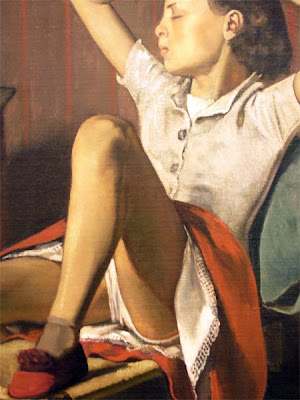
(my photograph of a painting by Balthus at the Metropolitan Museum of Art)

The world never loved safe havens, I guess. I should have paid more attention to the King Arthur legend.

Everyone remembers where they were when Kennedy was shot. I was on the playground at school. They called us all in to watch the news on TV. That night my family did something unusual for us--we went out to eat. Nothing fancy, of course, just a Morrison's Cafeteria, but I remember the hushed tones in that room more than anything else about the day. Even my parents seemed awkward.

And perhaps from that moment on, the awkwardness stayed with us always. The war in Vietnam played on TV every night as we ate our dinners. Soon, my mother (who I realize only now was in her early thirties) began wearing new styles. I didn't like it. I even resented it. I didn't want a mother who was hip. And she wasn't, really. We began to quarrel about the length of my hair. And maybe about everything else, too.

By the time I was fifteen, there was serious trouble in our house, and I didn't like coming home. I began hanging out at the homes of other kids. Homes, I call them, though they were already broken. But at least the arguments there were entertaining ins a macabre way. The troubles weren't mine. Home seemed a place to get away from. It was where all troubles lay.

I began hanging around the shopping center, too. It was one of the new big ones, a line of stores fronted by a giant parking lot. It had a Woolworth's and a Thom McCann's Shoes, two women's stores, a Lerner's and something else, a Belk Lindsey department store, a record store, a Liggett's Drug Store that had a small restaurant that served breakfast, lunch and dinner. There was another five and dime whose name I can't remember, but it had a long lunch counter, too. There was a new Publix grocery store and a branch of the county library tucked into an alley next to our dentist's office which was next to a Laundromat that you accessed from the shopping center's back side. Tucked away in the alley was a big pool hall. That was a bad idea, I think, which I will get to. On the very far end of the structure was a Tom's Pizza, a place that sold its square pizzas by the piece. That was where the older kids hung out, and later, when I too was older, it was a place I worked.

There was also a news stand that had a pinball machine. The woman who ran the place was rough with the kids. She was unpredictable, really. Thinking back on it now, it probably had to do with who else was in the store. When it was empty, we were able to peruse the sexy magazine's that she sold. There were a bunch of them and they were located right next to the pinball machine where we drank slurpees and smoked cigarettes and poured our quarters into its hungry slot. If you hung out there, you would see your buddies. Everyone came. It was tough. It was dangerous. But if you were there alone and business was slow, the woman behind the counter would sell you cigarettes and even the sexy magazines. Maybe. It was hit or miss.

That was where I heard about a new phenomena. There was a girl, they said, who would get naked for anybody. Her parents went square dancing every Saturday night and left her alone in the house. Some of the older boys would go over and get drunk and she would take her clothes off. It wasn't Saturday night when I went over. It was the middle of the week. I went with the boy who told me about all this. He was her neighbor. Her parents were home, so he took me to the back of her house, to the window of her room, and he pulled himself up on the sill and looked in. "She's in there," he whispered, and he tapped on the glass. Right away, she pulled the curtain aside. We were standing in the darkness bathed by the dim golden glow projected by the bare light bulb inside.

I couldn't believe what happened next. He told her he wanted to see her, but she said no, her parents were home. He whispered another incantation through the dirty screen and suddenly she was unhooking its retainers and pulling it aside. Then she got a chair and brought it to the window where she climbed up so we could get a better view. And then, standing there in that dim golden light shadowed now only by her, she gave me my first vision of womanhood. Girlhood, I guess, but you couldn't believe the thing when she pulled her nightgown up to her shoulders revealing herself in the naked light. My friend reached up and touched her, but only for a second. We were all nervous that her parents would come and so the whole encounter from the first tap on the window pane to the last act of replacing the dirty screen took no more than a couple minutes. It didn't matter, though. I'd been scarred.

The next day at school, I couldn't wait to tell my friends what I had seen. I was stupid, I guess, but I said it in a crowd where some girls were able to hear. That afternoon, the principal came and called me out of class. I liked him, generally, but I knew something bad was happening. I tried to talk to him as we walked, my heart racing like a speedboat, but he wouldn't say a word. When we got to his office, he told me to sit down and he closed the door. What could this be? I wondered. It was bad news for sure. Had there been an accident? Had somebody died? He sat down at his desk across from me and waited for a long moment before he asked me, "What did you do last night?" I wasn't prepared for that in any way and suddenly I was falling down, down, down, head over heals, spinning, twirling. I couldn't feel my tongue when I said, "Nothing." Then he asked me if I knew. . . and he said the name of the girl. And I don't know what happened next, but soon I was blurting out everything feeling myself a victim. Everybody was talking about it, I said, and so and so asked me to go over and I didn't know what we were doing and then she climbed up on the chair and I didn't even touch her or anything. . . . . I was righteous, a victim of unusual circumstances, unwitting and truly unwilling. And I could tell, even in my naiveté, that he had not expected to hear all this. After a while, he simply told me to go back to class.

For the next couple of days, boys were called into his office and questioned. And the whole sordid tale came out--everything. I was long forgotten by then. I was no more than the crack in the dam. But after each interview, every boy would come out and tell what he told and the next boy would be called in, and finally the girl's parents were there. By now, the whole school knew about what had been going on, and so did some of the other parents. I had been lucky to be the first called in, I think, and my parents never knew. In the end six boys were suspended for a week.

After that, no one would talk to the girl. But the oddest thing began to happen. She seemed to bloom right before our eyes. Every week, something changed, her clothing, her hair, and she grew by increments more and more attractive. Even the thing that had happened, I believe, was transformed gaining some supernatural illumination.  She seemed a sullied redneck Icon.  Her very presence seemed to glow.

Or maybe that was all just me and the way I learned to look at it then, but I must admit I developed a secret fondness for her that I could never confess.